
There is a massive paradigm shift happening in the way software is created. It’s called vibe coding.
Instead of sitting down and manually typing out thousands of lines of complex syntax by hand, creators, founders, and business leaders are now building software simply by describing what they want in everyday natural language. You prompt an AI: “Build me a client portal where customers can book appointments and view invoices” and the artificial intelligence writes the actual code for you.
It feels almost magical. However, as thousands of early adopters are discovering, relying purely on raw AI prompts quickly leads to technical debt, broken logic, and not really a production ready code.
The secret to turning a cool AI demo into a production-grade, scalable application lies in a single architectural concept: building on top of an enterprise AI framework like Twasta.ai.
To understand why AI struggles without structure, we have to look at what a software framework actually does.
Imagine you want to build a house from scratch:
In the digital world, a software framework is that pre-built foundation. It handles all the boring, repetitive, easy-to-get-wrong technical “plumbing” of an application such as database connections, user authentication, application security and data routing allowing the creator (and the AI) to focus exclusively on the unique features that make the app valuable.
When you pair conversational AI with an underlying application framework like Twasta, you give the model a set of rigid rails to run on. Here is why this combination transforms vibe coding from a tech gimmick into an enterprise asset:
When building on a structured framework, there are strict, pre-defined rules for where each piece of the application lives. Think of it like a professionally organized commercial kitchen where the knives, plates, and spices each have a designated drawer.
When you command the AI to “Add a secure login screen,” it doesn’t have to guess how to structure the security logic or where to drop the files. It simply follows the framework’s blueprint. Without a framework, the AI invents a completely arbitrary layout every single time you send a prompt, quickly turning your codebase into a messy junk drawer that no human developer can fix.
Most of the code inside a standard business application consists of repetitive backend infrastructure that every app needs to function. A robust framework already provides this out of the box.
Because the infrastructure is pre-built, the AI has far less code to write. Less code written translates directly to:
You are asking the AI to paint the walls and design the interior, not reinvent the concept of bricks.
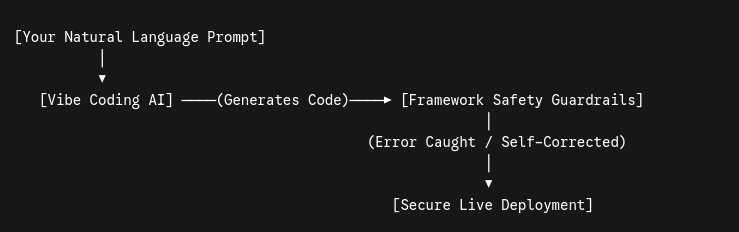
Enterprise-grade frameworks ship with automated validation protocols. The exact millisecond the AI writes a snippet of code that deviates from architectural best practices, the framework’s internal system flags it.
This is a game-changer for conversational programming. Instead of errors quietly hiding in the background until a paying customer encounters a system crash, the AI receives instantaneous feedback. It operates exactly like an advanced spell-checker, allowing the AI model to self-correct its course immediately.
Large Language Models (LLMs) are trained on vast repositories of open-source and standardized code. If you ask an AI to invent an entirely new software architecture from scratch, it is forced to hallucinate and guess.
However, if you ask it to build within standard industry framework patterns, you are playing directly to the AI’s greatest strength. It is pulling from millions of clean, verified examples, resulting in highly reliable outputs.
Software is never truly finished; real-world business tools evolve. You might ask your AI assistant for a basic database today, three new feature modules next month, and a custom API integration next quarter.
Because an engine like Twasta enforces a consistent visual and structural shape, all subsequent AI modifications click together cleanly—exactly like LEGO bricks. Without that framework foundation, every new feature request pulls the codebase in a chaotic direction until the entire application becomes incredibly fragile and impossible to update.
A secure framework ships out of the box with built-in protections against common vulnerabilities, such as SQL injections, cross-site scripting (XSS), and unauthorized data leaks.
When the AI generates your application on top of this foundation, your software inherits these security protocols automatically. Vibe coding completely in the wild without a framework can easily result in the AI accidentally leaving digital backdoor vulnerabilities wide open, simply because no human explicitly told the prompt box to build the locks.
Trust is the ultimate bottleneck of AI-generated software. If you cannot understand what the AI built, you cannot safely deploy it to your customers.
Because a framework organizes code into predictable, standardized blocks, platforms like Twasta allow you to inspect the entire application layout visually. You don’t need to read thousands of lines of code; you can view the system components visually, run an instant interactive preview, and verify the logic on the spot. This visual confirmation shifts vibe coding from a conceptual experiment into a practical business utility.
The ultimate pitfall of standalone AI code generation is that prototypes usually have to be completely scrapped and rewritten by human developers once the company scales.
An architecture built on an advanced framework solves this entirely. The exact same infrastructure that allows you to rapidly vibe-code a rough prototype in an afternoon is the enterprise foundation capable of supporting thousands of paying users down the road. You never have to tear down your progress; you just keep expanding upward.
While conversational programming on top of a framework is the gold standard for the vast majority of software development, it is important to understand the edge cases where this model doesn’t apply:
Vibe coding fundamentally changes the role of a software creator from writing instructions to declaring business outcomes. It is an incredibly liberating shift, but it requires a structured environment to succeed.
An AI framework like Twasta.ai quietly manages the thousands of microscopic technical complexities that natural language cannot easily communicate. By providing the AI engine with predictable rails to run on, “just describe your idea and watch it appear” transitions from an unpredictable playground into a dependable, institutional reality.