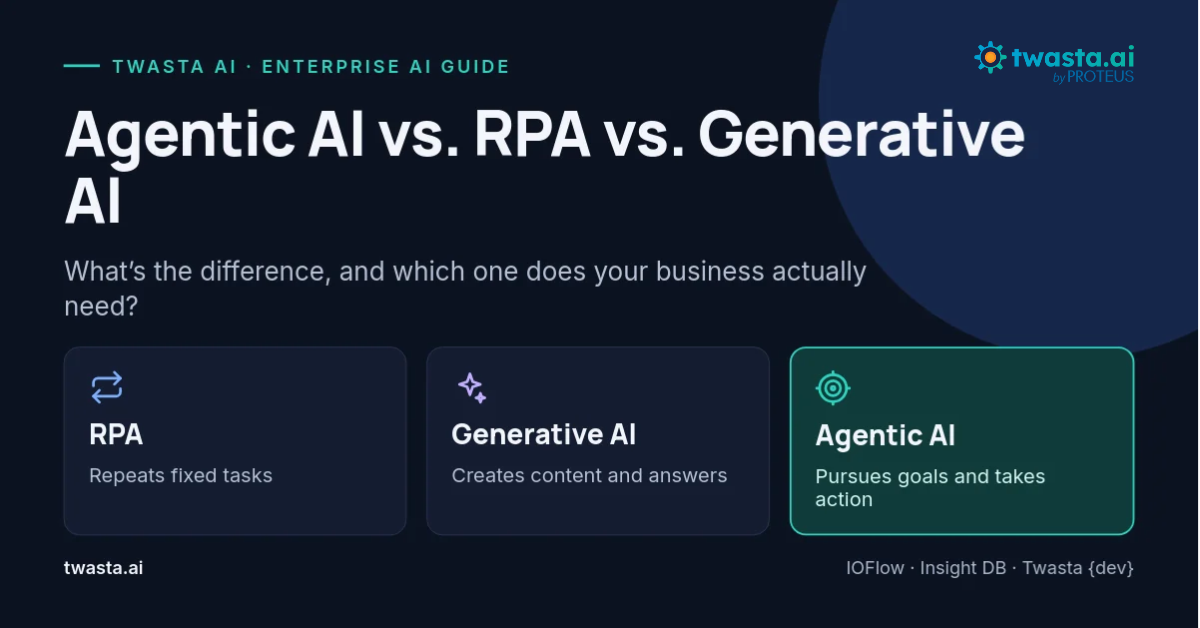
Comparison of RPA, generative AI and agentic AI for enterprise automation

Agentic AI vs. RPA vs. Generative AI: What’s the Difference and Which Do You Need?

If you have sat through a technology meeting recently, you have probably heard three terms thrown around as if they mean the same thing: RPA, generative AI and agentic AI. They do not. Each solves a different kind of problem, and choosing the wrong one can mean wasted budget, stalled pilots and frustrated teams.

This guide explains each technology in plain language, compares them side by side, and helps you decide which one your business actually needs.

The Quick Answer

  • RPA follows fixed rules to repeat simple tasks. Think of it as a digital typist.
  • Generative AI creates content and answers questions. Think of it as a smart assistant.
  • Agentic AI understands a goal, plans the steps, uses your systems and gets the job done. Think of it as a digital team member.

Most enterprises will end up using all three. The skill is knowing which one fits which job.

What Is RPA (Robotic Process Automation)?

RPA uses software “bots” to copy what a human does on a screen: clicking buttons, copying data between systems, filling in forms. The bot follows a script exactly. If the screen layout changes, or an input arrives in a format the script does not expect, the bot usually stops or fails.

Best at: high-volume, repetitive, rule-based tasks where the steps never change.

Examples:

  • Copying data from a spreadsheet into an ERP system
  • Generating the same weekly report in a fixed format
  • Moving records between two applications

What Is Generative AI?

Generative AI uses large language models (LLMs) to create new content: text, summaries, code, images and answers to questions. You give it a prompt and it responds.

Best at: understanding and producing language, summarizing information and helping people work faster.

Examples:

  • Summarizing a 40-page contract
  • Drafting an email reply or a product description
  • Explaining a dataset in plain English
  • Suggesting code for a developer

What Is Agentic AI?

Agentic AI goes a step further. Instead of just answering, an AI agent is given a goal and works toward it. It can plan a sequence of steps, use tools and software systems, check the results and adjust if something goes wrong.

An agentic system typically combines:

  • Reasoning to decide what to do next
  • Tool use to take action in your applications, documents and APIs
  • Memory and context to stay on track across several steps
  • Workflow orchestration to coordinate everything end to end

Best at: complex, multi-step processes that involve judgment, exceptions and several different systems.

Examples:

  • Receiving an invoice by email, reading it, matching it with a purchase order, flagging mismatches and routing it for approval
  • Handling a customer request by checking records, updating systems and replying with the outcome
  • Collecting data from several sources and preparing a decision-ready report

Side-by-Side Comparison


RPA

Generative AI

Agentic AI

What it does

Repeats fixed steps

Creates content and answers

Pursues a goal and takes action

Handles messy or unstructured data?

No

Yes

Yes

Handles exceptions?

Poorly

Suggests options

Yes, within set rules

Acts across systems?

Yes, by following scripts

Not by itself

Yes, planned dynamically

Needs human input?

Only for setup and failures

Every time you prompt it

Oversight at key decision points

Best for

Stable, repetitive tasks

Knowledge work and content

End-to-end workflows

Simple analogy

Digital typist

Smart assistant

Digital team member

One Example, Three Approaches: Processing an Invoice

The easiest way to see the difference is to take one business task and run it through each technology.

  • With RPA: A bot copies data from a standard invoice template into your accounting system. If a supplier sends a different layout, the bot breaks and a human steps in.
  • With generative AI: An employee uploads the invoice and asks an AI tool to summarize it or extract the key fields. It does this well, but the employee still has to enter the data, check it and send it for approval.
  • With agentic AI: The agent reads the invoice in any format, extracts the details, checks them against the purchase order, spots a price mismatch, raises it with the right person and routes the corrected invoice for approval. The human reviews only the exception.

Which One Do You Need?

Choose RPA if…

  • The process is stable and follows clear rules
  • The data is structured and consistent
  • You need a quick win on a repetitive task

Choose generative AI if…

  • Your teams spend time reading, writing, searching or summarizing
  • You want to help people work faster rather than automate a whole process
  • The output is reviewed by a person before it is used

Choose agentic AI if…

  • The process spans multiple systems, documents or teams
  • Inputs vary and exceptions are common
  • You want the process completed, not just assisted
  • Delays and manual handoffs are costing you time and money

5 Common Mistakes to Avoid

  1. Automating a broken process. Fix or simplify the process first, then automate it.
  2. Using AI where simple rules would do. Not every task needs an agent.
  3. Skipping governance. Define what an agent may and may not do, and keep audit trails.
  4. Removing humans completely. Keep people in the loop for high-stakes decisions.
  5. Starting too big. Pick one high-impact workflow, prove the value, then scale.

How Twasta AI Can Help

At Twasta AI, built by Proteus Technologies, we help enterprises put the right kind of AI in the right place:

  • IOFlow: An AI-powered hyperautomation platform that orchestrates end-to-end workflows across systems, documents and APIs, so your processes run without constant manual handoffs.
  • Insight DB: Ask questions directly to your databases in plain English and get instant, data-driven answers without waiting for manual queries or dashboards.
  • Twasta {dev}: Build scalable, enterprise-grade applications faster with an AI-optimized development platform.
  • AI Consulting: Identify your highest-impact AI opportunities and design a practical strategy before you invest.


Curious how IOFlow compares with other automation tools? Read our guide on n8n vs. IOFlow.

Conclusion

RPA, generative AI and agentic AI are not competitors. They are tools for different jobs. RPA repeats, generative AI creates, and agentic AI acts. The businesses that get the most value are the ones that match the right tool to the right process and start with a clear, focused use case.

Ready to find out where AI can make the biggest difference in your business? Contact the Twasta AI team for a conversation about your workflows, or write to marketing@proteustech.in.

Frequently Asked Questions

Is agentic AI the same as generative AI?

No. Generative AI creates content and answers prompts. Agentic AI uses AI models, often generative ones, to pursue a goal and take action across systems. Generative AI is often one ingredient inside an agentic system.
Not entirely. RPA is still a dependable, cost-effective choice for stable, rule-based tasks. Many organizations keep RPA for those jobs and add agentic AI for work that needs judgment and flexibility.
It can be, when it is built with clear boundaries, access controls, audit trails and human approval for important decisions. Governance matters as much as technology.