
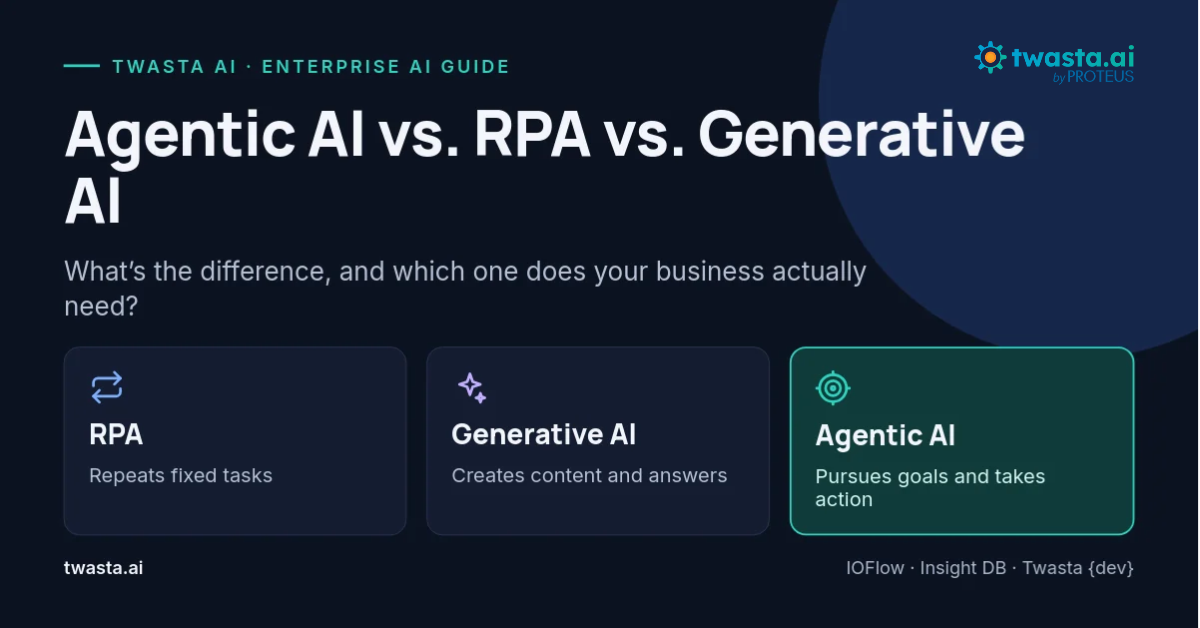
If you have sat through a technology meeting recently, you have probably heard three terms thrown around as if they mean the same thing: RPA, generative AI and agentic AI. They do not. Each solves a different kind of problem, and choosing the wrong one can mean wasted budget, stalled pilots and frustrated teams.
This guide explains each technology in plain language, compares them side by side, and helps you decide which one your business actually needs.
Most enterprises will end up using all three. The skill is knowing which one fits which job.
RPA uses software “bots” to copy what a human does on a screen: clicking buttons, copying data between systems, filling in forms. The bot follows a script exactly. If the screen layout changes, or an input arrives in a format the script does not expect, the bot usually stops or fails.
Best at: high-volume, repetitive, rule-based tasks where the steps never change.
Examples:
Generative AI uses large language models (LLMs) to create new content: text, summaries, code, images and answers to questions. You give it a prompt and it responds.
Best at: understanding and producing language, summarizing information and helping people work faster.
Examples:
Agentic AI goes a step further. Instead of just answering, an AI agent is given a goal and works toward it. It can plan a sequence of steps, use tools and software systems, check the results and adjust if something goes wrong.
An agentic system typically combines:
Best at: complex, multi-step processes that involve judgment, exceptions and several different systems.
Examples:
RPA | Generative AI | Agentic AI | |
What it does | Repeats fixed steps | Creates content and answers | Pursues a goal and takes action |
Handles messy or unstructured data? | No | Yes | Yes |
Handles exceptions? | Poorly | Suggests options | Yes, within set rules |
Acts across systems? | Yes, by following scripts | Not by itself | Yes, planned dynamically |
Needs human input? | Only for setup and failures | Every time you prompt it | Oversight at key decision points |
Best for | Stable, repetitive tasks | Knowledge work and content | End-to-end workflows |
Simple analogy | Digital typist | Smart assistant | Digital team member |
The easiest way to see the difference is to take one business task and run it through each technology.
Choose RPA if…
Choose generative AI if…
Choose agentic AI if…
At Twasta AI, built by Proteus Technologies, we help enterprises put the right kind of AI in the right place:
Curious how IOFlow compares with other automation tools? Read our guide on n8n vs. IOFlow.
RPA, generative AI and agentic AI are not competitors. They are tools for different jobs. RPA repeats, generative AI creates, and agentic AI acts. The businesses that get the most value are the ones that match the right tool to the right process and start with a clear, focused use case.
Ready to find out where AI can make the biggest difference in your business? Contact the Twasta AI team for a conversation about your workflows, or write to marketing@proteustech.in.